2-7 Triple Draw strategy: heads-up against three-handed
We solved fixed-limit 2-7 Triple Draw from the deal twice: heads-up, then with a third player at the table. Blinds of 5 and 10, bets of 10 and 20, 5 bets a round.
How to play it
- Heads-up on the button, raise almost every hand that needs two new cards or fewer: the solve raises 77% of its hands, limps 7% and folds 16%. Most of what it folds needs three or more new cards.
- With both blinds behind you, fold far more: three-handed, the button folds 53% of its hands and raises 45%.
- Heads-up, the big blind defends 84% of its hands against that raise and re-raises 26%. Three-handed, once the small blind folds, it defends 76%.
- Three-handed, the small blind folds 67% of its hands to the button’s raise and re-raises 14%.
- Don’t stand pat on a made ten just because it is made. With ten-eight-six-four-deuce on the first draw, break the ten: heads-up, drawing one is worth +1.58 big bets and standing pat +1.34 big bets.
The table we solved
- Game
- 2-7 Triple Draw: the lowest hand wins, deuce to seven, so aces are high and straights and flushes count against you. Three draws, four betting rounds, fixed limit, played from the deal.
- Blinds and bets
- Blinds of 5 and 10, a small bet of 10 before the second draw and a big bet of 20 after it, at most 5 bets a round, and limps allowed: the draw screen’s own settings. No ante.
- Seats
- Heads-up, the button posts the small blind and acts first before the draw. After it, the big blind acts and draws first. Three-handed, the button posts nothing and acts first before the draw, then the small blind, then the big blind. After each draw the small blind acts first, and the seats draw in that order.
The button first in: what does a third player change?
Heads-up, only the big blind is left to act. Three-handed, the small blind and the big blind both are.
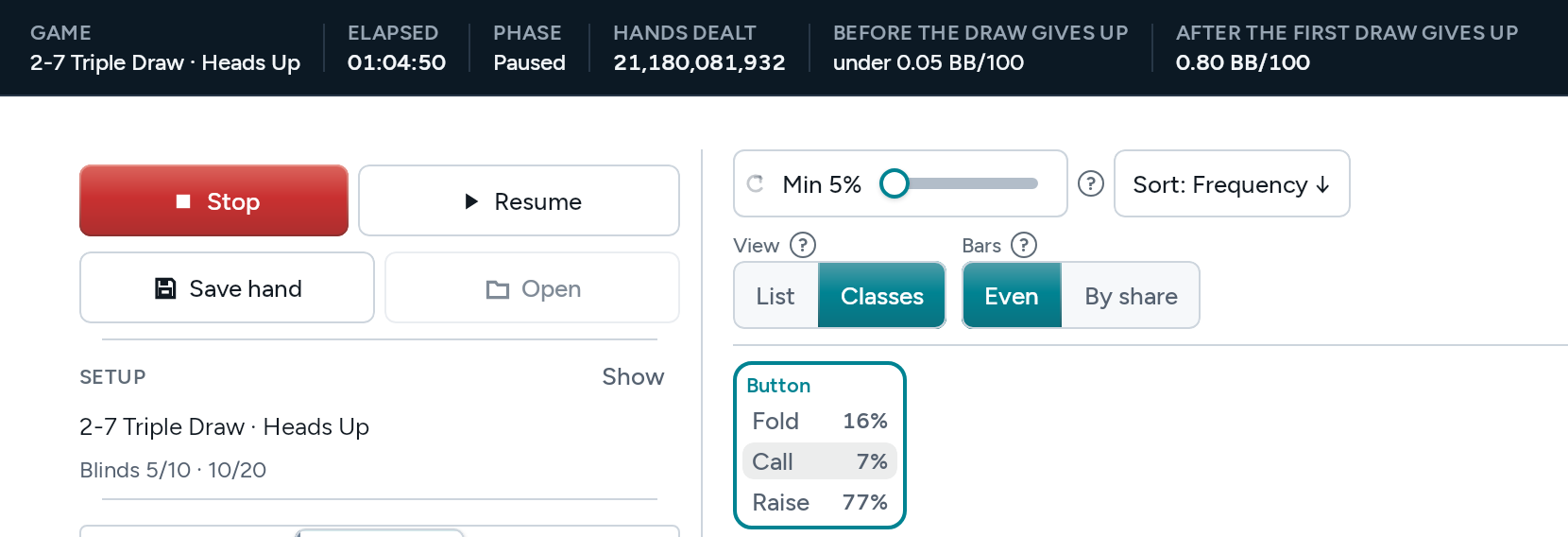
| The button, first in | Heads-up | Three-handed |
|---|---|---|
| Folds | 16% | 53% |
| Limps | 7% | 1% |
| Raises | 77% | 45% |
With three cards to a 6, the button raises 85% of the time heads-up and 32% three-handed.
Heads-up, the button raises almost every hand that needs two new cards or fewer, and most of what it folds needs three or more. With both blinds behind it, it folds more than half its hands, those that need three or more cards above all, and it almost never limps: 1% of its hands.
The big blind against the raise: call or re-raise?
The button raises. Three-handed, the small blind folds. The big blind folds, calls or re-raises.
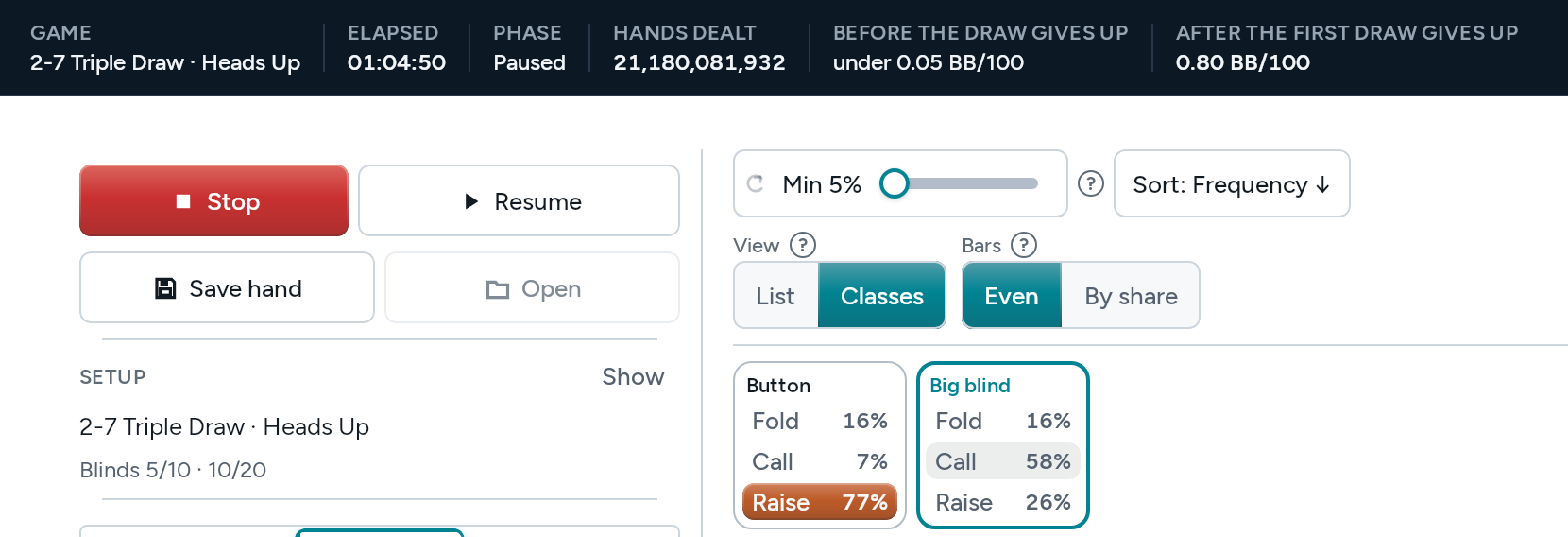
| The big blind against the raise | Heads-up | Three-handed |
|---|---|---|
| Folds | 16% | 24% |
| Calls | 58% | 65% |
| Re-raises | 26% | 11% |
With one card to a 7, the big blind re-raises 86% of the time heads-up.
Heads-up, the big blind calls with most of its hands. It re-raises almost every made 9 or better and one-card draw to a 7 or an 8, and around half its made jacks, its one-card draws to a 9 or worse and its two-card draws to a 6 or a 7. Three-handed, once the small blind folds, it folds 24% and re-raises less often, 11%, against a button that raised far fewer hands.
Three-handed, the small blind: fold, call or re-raise?
The button raises. The small blind folds, calls or re-raises, with the big blind still to act behind it.
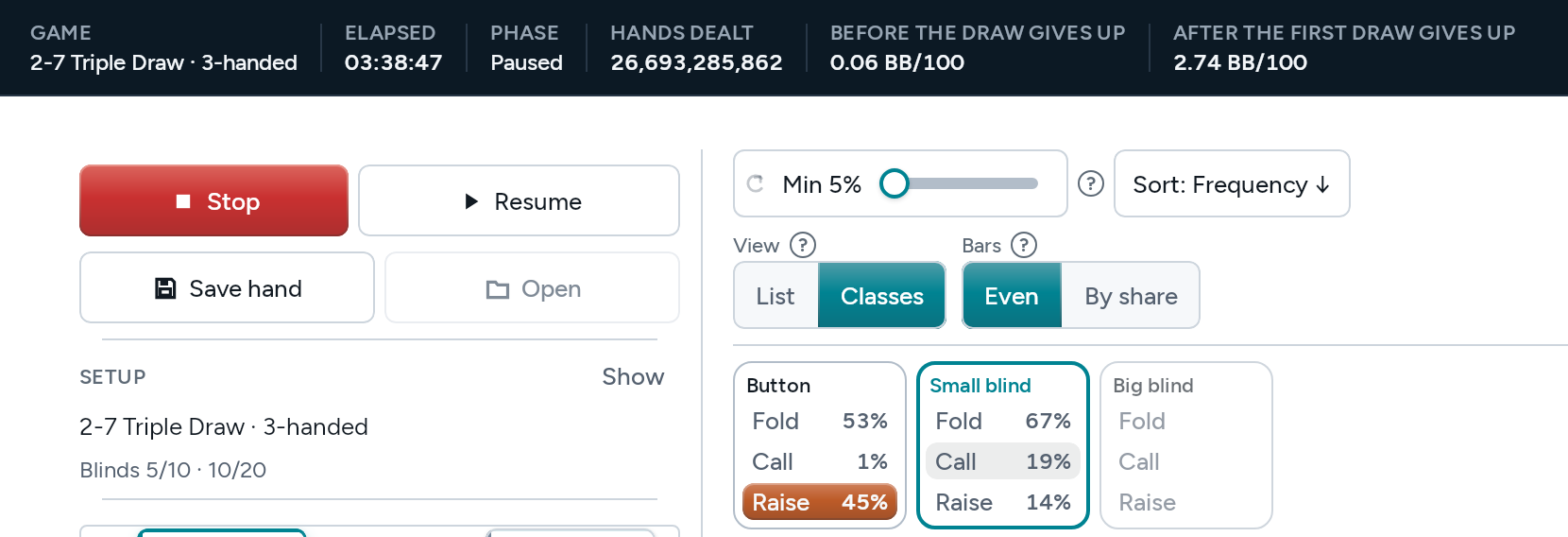
| The small blind against the raise | Three-handed |
|---|---|
| Folds | 67% |
| Calls | 19% |
| Re-raises | 14% |
With one card to a 7, the small blind re-raises 74% of the time.
The small blind folds two hands in three: the big blind is still to act behind it, and it acts first after every draw. When it plays, one-card draws to a 7 or an 8 re-raise most of the time, and two cards to a 6 or a 7 call more often than they fold or re-raise.
The first draw: break a made ten?
The big blind called the raise, so it draws first. It holds ten-eight-six-four-deuce, a made ten.
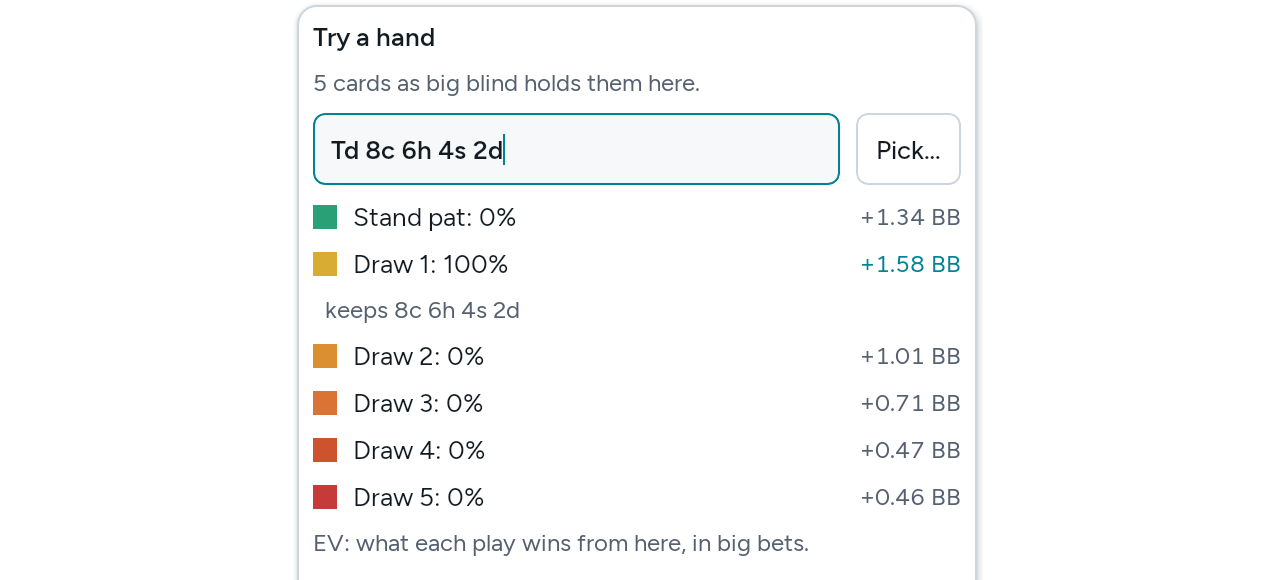
| Ten-eight-six-four-deuce, EV in big bets | Heads-up | Three-handed |
|---|---|---|
| Draws one | +1.58 | +1.45 |
| Stands pat | +1.34 | +1.14 |
What each play wins from the draw on, as Try a hand shows it; drawing one keeps 8-6-4-2. Try a hand plays the hand out over many deals, so its EVs move by a few hundredths each time they are worked out.
Ten-eight-six-four-deuce is a made ten, but the big blind throws the ten and draws one every time, heads-up and three-handed. Most of its other made tens break too, and most of those draw two.
What the third player changes
The same table, heads-up and three-handed: the button first in, then the big blind against its raise, three-handed once the small blind folds. The last row is drawing one with ten-eight-six-four-deuce, in big bets.
| Heads-up | Three-handed | |
|---|---|---|
| Button folds | 16% | 53% |
| Button raises | 77% | 45% |
| Big blind defends | 84% | 76% |
| Big blind re-raises | 26% | 11% |
| 10-8-6-4-2 draws one | +1.58 | +1.45 |
What stays the same: the button never folds a made 9 or better, heads-up or three-handed, and ten-eight-six-four-deuce draws one both ways.
How we solved it
- HydraSolver 1.2.12, 2-7 Triple Draw (beta), from the deal, with the draw screen’s blinds, bets and limps.
- Each solve ran with a stop target of 0.05 big bets per 100 hands. The heads-up solve paused itself at that target; the limps kept turning into raises after it, so we resumed it and paused it by hand. The three-handed solve paused itself once it stopped improving, and we resumed and paused it the same way.
- Accuracy reached, before the first draw: heads-up under 0.05 big bets per 100 hands, three-handed 0.06. Three-handed, the betting after the first draw gives up 2.74 big bets per 100 hands, so this page quotes none of it. Try a hand’s three-handed EVs rest on that betting too, but drawing one with ten-eight-six-four-deuce beats standing pat by far more than that.
- Every percent is as HydraSolver’s draw screen shows it, in the seat boxes and the Classes view; a seat that defends calls or re-raises. EVs are in big bets, from Try a hand. Read how we measure draw accuracy on the 2-7 Triple Draw proof.
Study it yourself
- Solve your own table
In Settings, Game setup, pick 2-7 Triple Draw (beta). Solve & Study opens the draw screen: keep the blinds and bets, pick Heads Up or 3-handed, set the stop target to 0.05 and press Start. Try a hand, beside the class table, shows what standing pat and each draw are worth for the hand you type.
2-7 Triple Draw Solver → - Try it for 10 days
The full version for $150. Upgrade to a license for the difference at any time.
Start a trial →
More
Buy HydraSolver — $899 Try 10 days — $150 ← All strategy pages