PLO5 strategy: what the fifth card changes
We solved one five-handed Pot-Limit Omaha table twice, with five hole cards and with four, on the same tree with the same bet sizes. Then we solved one river exactly from each. Every frequency and EV on this page comes from those solves. How often each kind of hand is dealt comes from counting the cards.
What the solve says
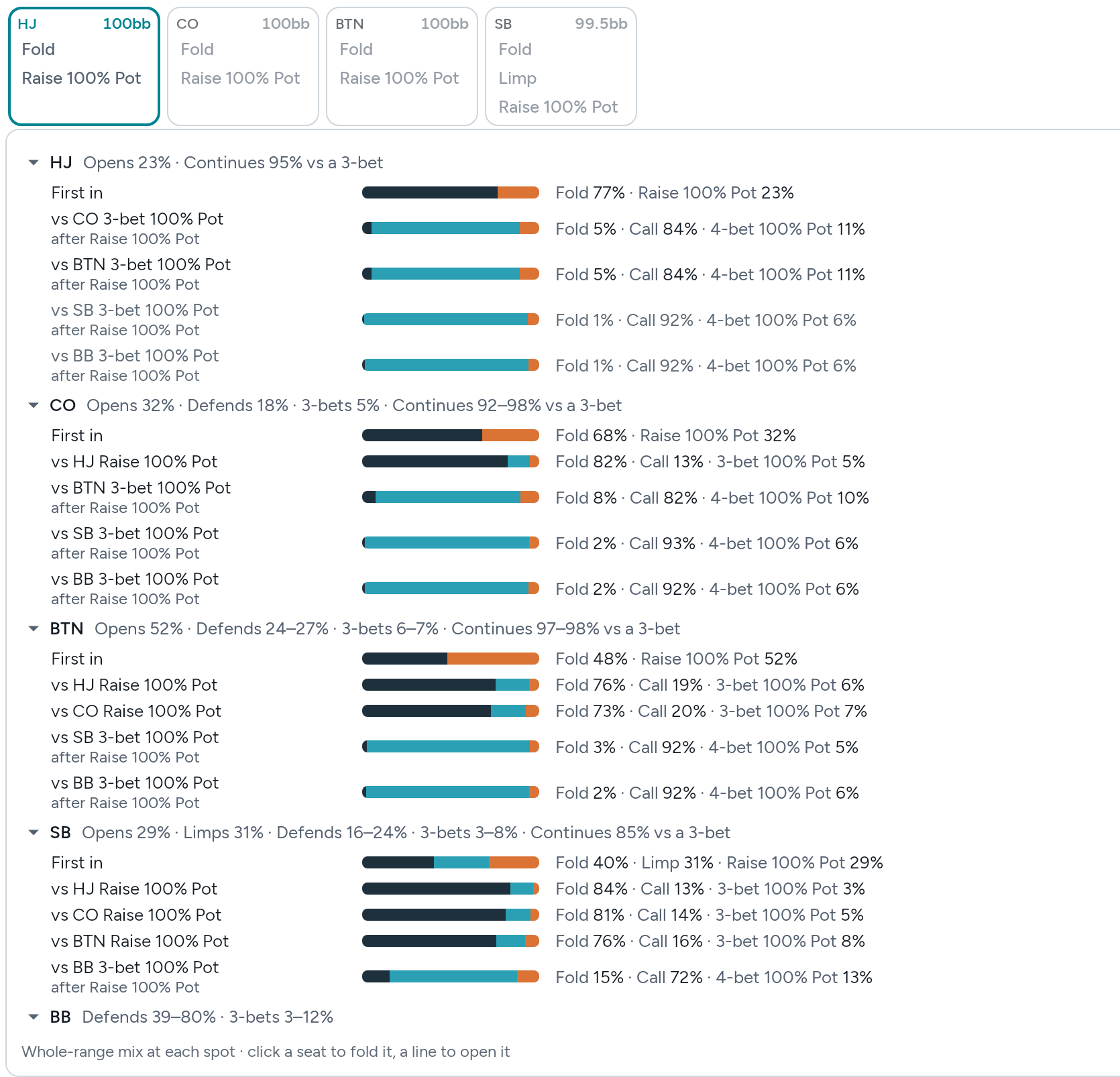
- First in from the hijack, the cutoff or the button, the fifth card barely changes how often you raise: 23.4% of your hands from the hijack, 32.4% from the cutoff and 51.8% from the button. With four cards on the same tree: 23.1%, 32.2% and 51.6%.
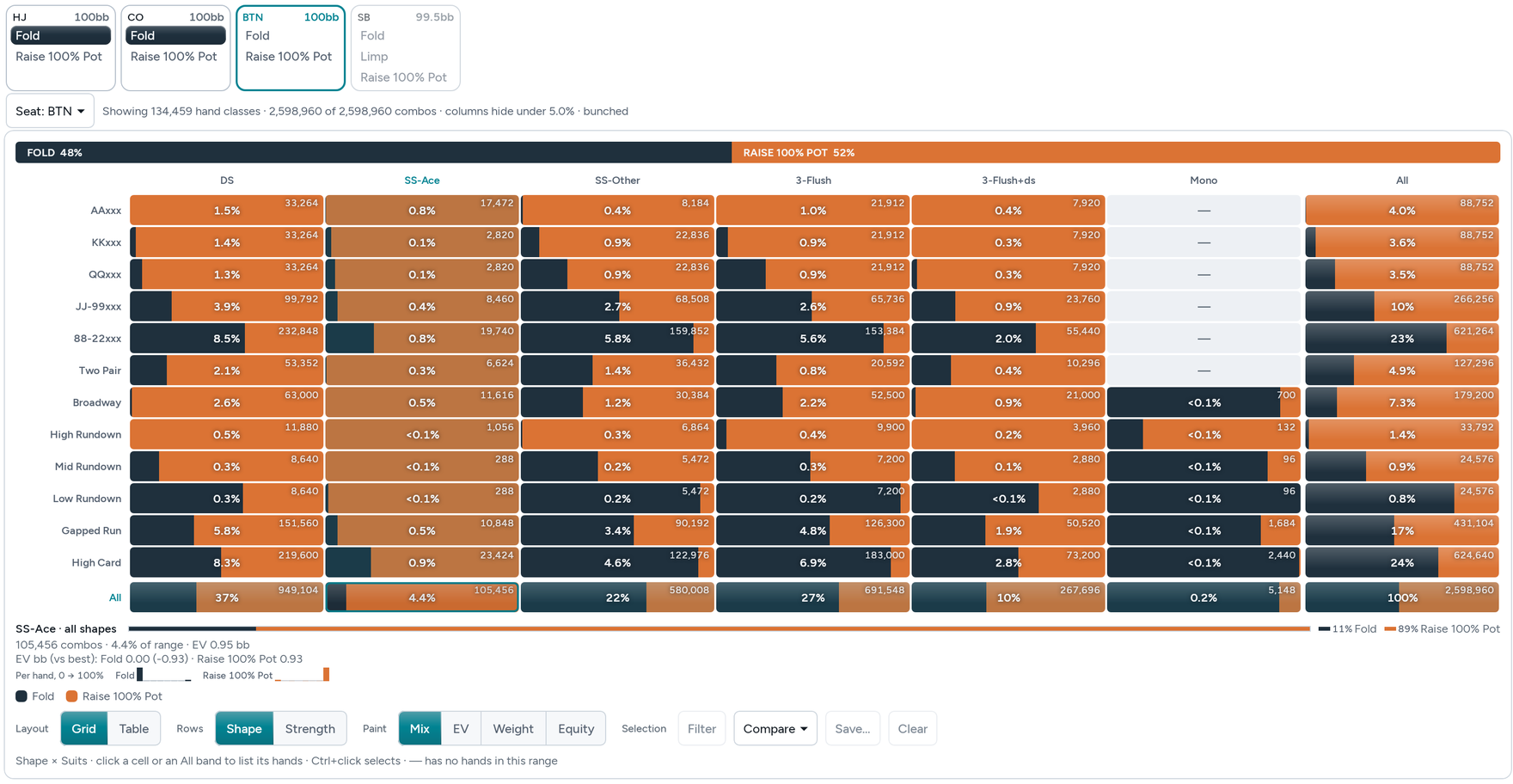
- On the button, you raise a smaller share of your double-suited and two-pair hands with five cards: 66% and 75%, against 83% and 99% with four.
- In the big blind, facing a hijack raise, you fold 61% with five cards and 65% with four. Facing a button raise, you fold about 46% in both games.
- Facing the big blind’s 3-bet, the button folds 2.1% with five cards and 4.6% with four.
- On J♥8♣3♦2♠9♦ after the line below, facing the big blind’s pot bet, the button raises 15.0% with five cards and 8.7% with four.
The table we solved
- Game
- Pot-Limit Omaha with five hole cards (PLO5), five-handed: hijack, cutoff, button, small blind, big blind. The comparison: the same tree with four hole cards.
- Stacks
- 100bb each, blinds 0.5 / 1, no rake
- Bet sizes
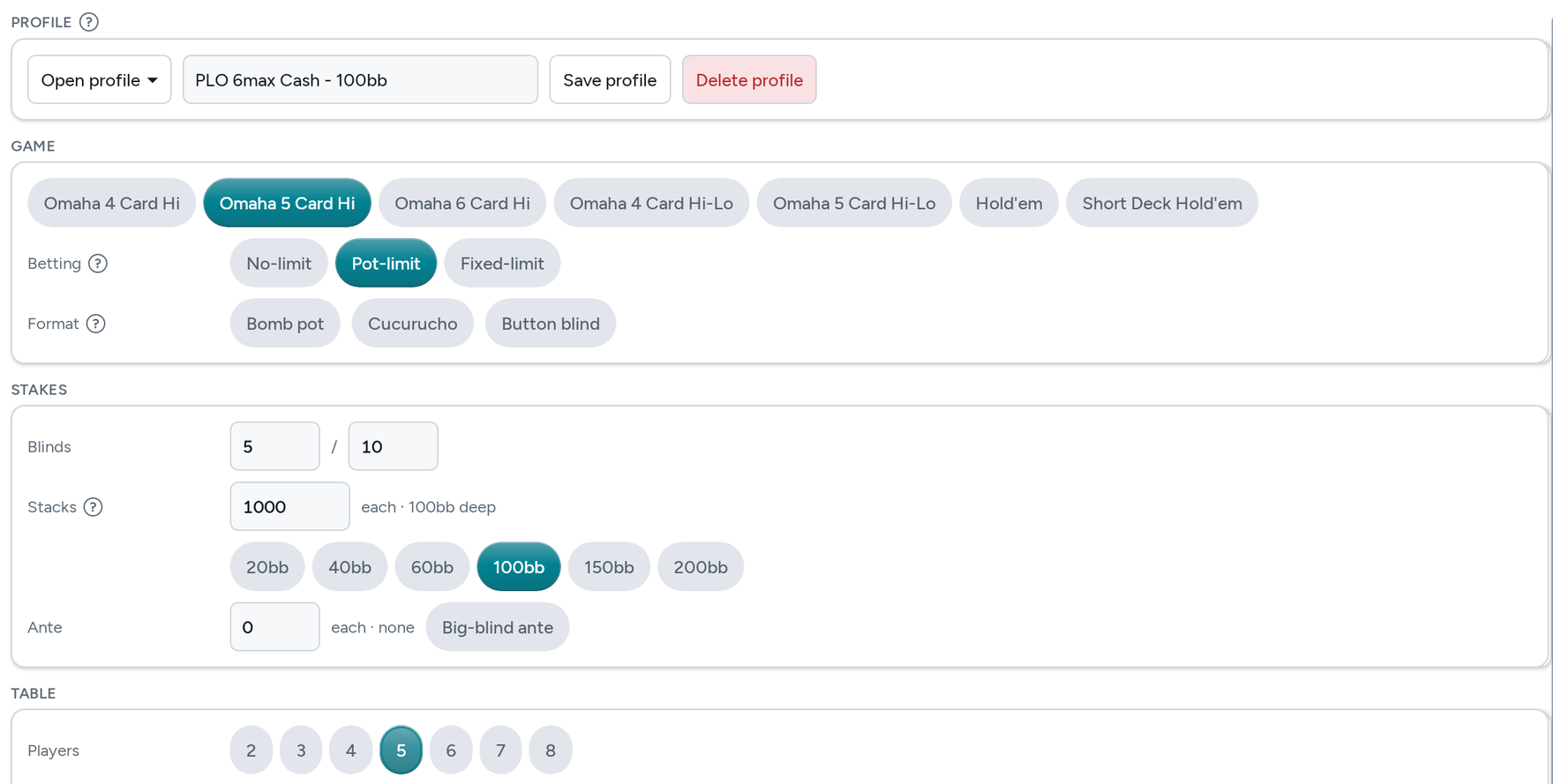
- The Tree Wizard’s PLO 6max Cash - 100bb profile at five players: every open is a pot raise, to 3.5 bb (3 bb from the small blind). Flop bets half pot, turn three quarters, river pot; raises are three quarters of the pot on the flop and pot on the turn and river.
- Ranges
- Every seat starts with every hand. The solves find the ranges.
- Rules as solved
- Pot limit. Each hand uses exactly two of its hole cards and three board cards.
First in: does the fifth card change how often you raise?
Folded to each seat in turn.
| % of hands | Five cards | Four cards |
|---|---|---|
| Hijack raises first in | 23.4% | 23.1% |
| Cutoff raises first in | 32.4% | 32.2% |
| Button raises first in | 51.8% | 51.6% |
| Small blind limps first in | 30.9% | 34.6% |
| Small blind raises first in | 28.5% | 26.8% |
| Big blind raises a small blind limp | 47.7% | 49.0% |
Each seat folds or raises the pot. The small blind can also limp.
On the same tree, the hijack’s, cutoff’s and button’s first-in raises each move by less than half a point between five cards and four. The small blind limps less and raises more with five cards: it limps 31% and raises 29%, against 35% and 27% with four.
On the button: which hands does the fifth card change?
Folded to the button. The share of each kind of hand it raises first in, grouped as HydraSolver’s Chart groups them.
| Button raises first in | Five cards | Four cards |
|---|---|---|
| Double-suited | 66% | 83% |
| Single-suited, with a suited ace | 89% | 89% |
| Single-suited, no suited ace | 35% | 41% |
| Aces | 100% | 100% |
| Kings | 95% | 99% |
| Jacks to nines | 65% | 81% |
| Eights to twos | 27% | 35% |
| Two pair | 75% | 99% |
| Broadway | 84% | 98% |
| High rundowns | 98% | 100% |
| Low rundowns | 23% | 60% |
| Gapped runs | 54% | 70% |
| High card | 31% | 36% |
Whole percents, as HydraSolver’s Chart shows them with Bunching on. A four-card hand with three of one suit counts as single-suited. Five-card hands with three of one suit have columns of their own, which four-card PLO does not have.
The button raises the same share of its hands with five cards, and no hand shape more often. Five-card hands are dealt as different kinds: 37% of them are double-suited against 13% of four-card hands, and 24% are high-card hands against 53%.
In the big blind: how wide do you defend?
One pot raise in front, every other seat folded.
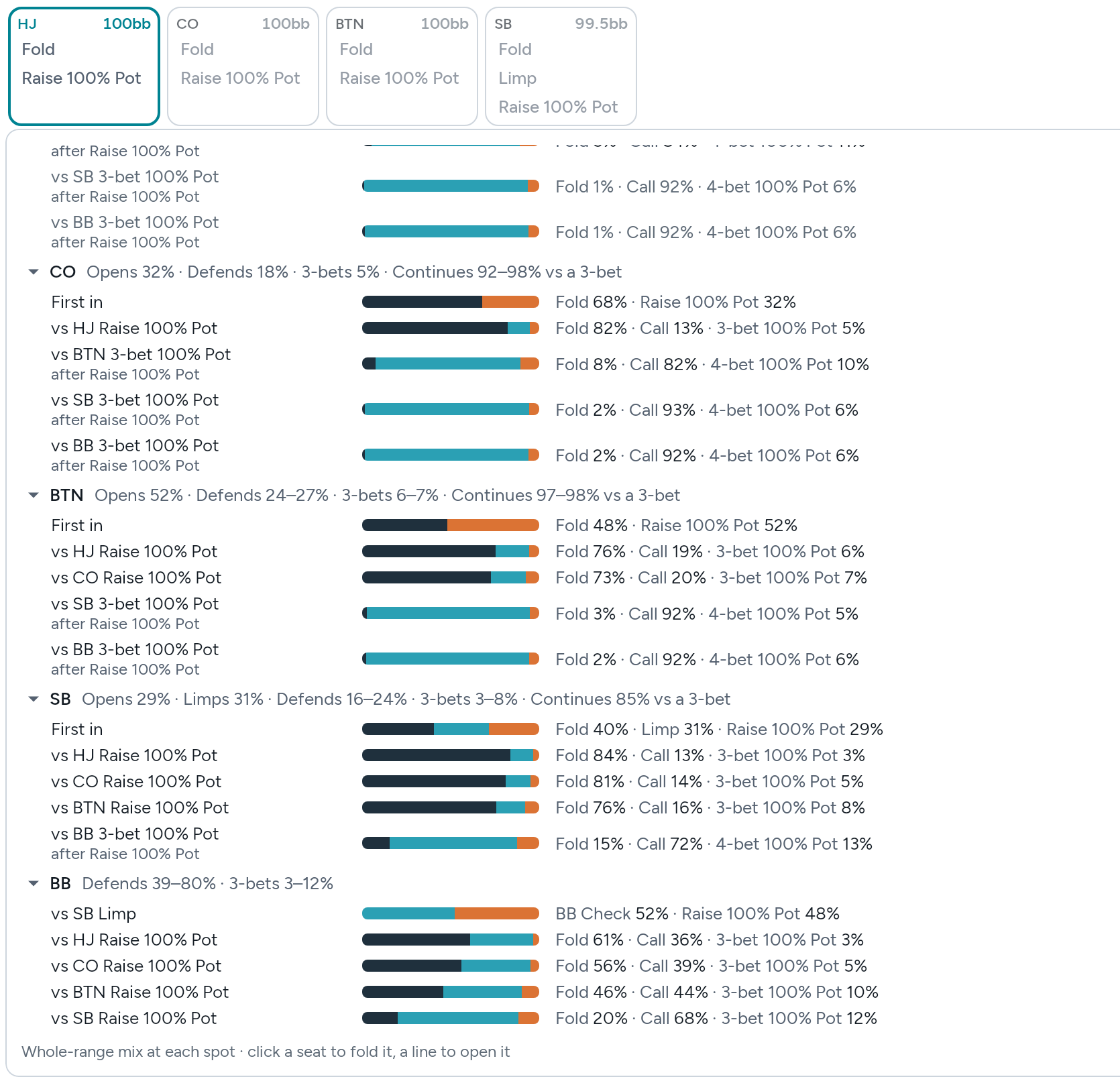
| Facing | Five cards: folds | Five cards: raises | Four cards: folds | Four cards: raises |
|---|---|---|---|---|
| Big blind against a hijack raise | 61.2% | 3.3% | 64.7% | 4.2% |
| Big blind against a cutoff raise | 55.8% | 5.1% | 58.2% | 5.9% |
| Big blind against a button raise | 45.7% | 9.8% | 46.1% | 10.0% |
| Big blind against a small blind raise | 19.9% | 11.8% | 17.5% | 10.9% |
| Button against the big blind’s 3-bet | 2.1% | 5.8% | 4.6% | 6.5% |
Raises: a pot 3-bet, or for the button facing the 3-bet, a pot 4-bet. The rest call.
Against the hijack and the cutoff, the big blind defends wider with five cards. Against a button raise the two games are within half a point of each other, and against a small blind raise the big blind folds a little more with five cards: 20% against 18%.
One river: who bets, and who folds?
The button raises the pot, the small blind folds, the big blind calls. J♥8♣3♦: the big blind checks, the button bets half pot, the big blind calls. 2♠ checks through. River 9♦, 15.1 bb in the pot.
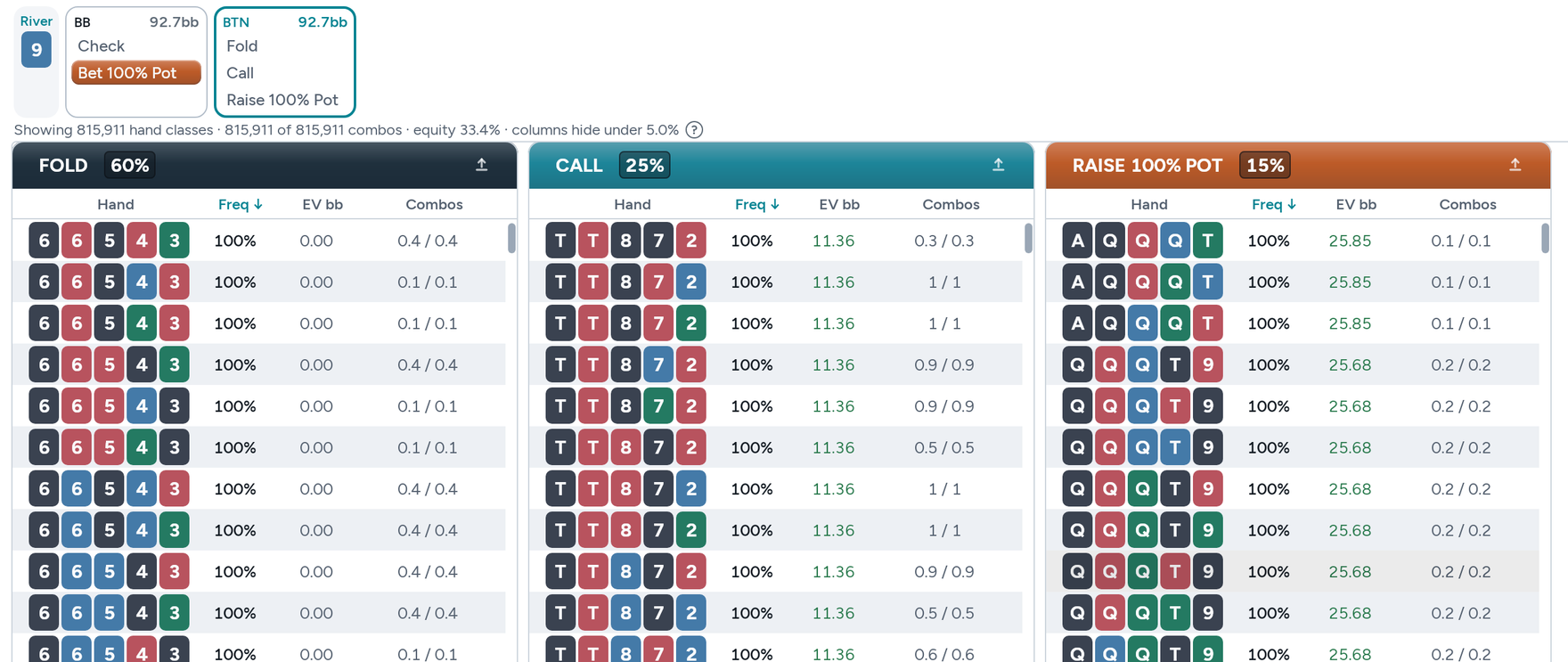
| River decision | Five cards | Four cards |
|---|---|---|
| Big blind bets pot first | 34.3% | 39.2% |
| Button folds to that bet | 59.8% | 66.4% |
| Button calls that bet | 25.1% | 24.9% |
| Button raises that bet | 15.0% | 8.7% |
| Button bets pot after a check | 36.0% | 25.0% |
| Big blind folds to that bet | 54.1% | 52.7% |
| Big blind raises that bet | 9.5% | 7.8% |
Each solve brings its own ranges to this river. Of the hands this board leaves possible, the big blind arrives with 18% with five cards and 22% with four, the button with 13% and 15%.
With five cards the big blind bets a little less often, and the button raises its bet more often: 15.0% against 8.7%. After a check, the button bets 36% with five cards and 25% with four.
What each seat wins per hand
Seat EVs from each preflop solve: chips won or lost per hand, in big blinds.
| Seat | Five cards | Four cards |
|---|---|---|
| Hijack | +0.16 bb | +0.14 bb |
| Cutoff | +0.22 bb | +0.20 bb |
| Button | +0.34 bb | +0.32 bb |
| Small blind | −0.27 bb | −0.26 bb |
| Big blind | −0.44 bb | −0.42 bb |
What barely moves: each seat’s EV stays within 0.02 bb of the four-card solve.
At the table
- First in from the hijack, the cutoff or the button, raise about the share of hands you would in four-card PLO. The solve raises 23% from the hijack, 32% from the cutoff and 52% from the button.
- On the button, raise a smaller share of your double-suited and two-pair hands than in four-card PLO. The solve raises 66% and 75% of them, against 83% and 99% with four cards.
- On the button, facing the big blind’s 3-bet, almost never fold. The solve folds 2.1%.
How this solve was created
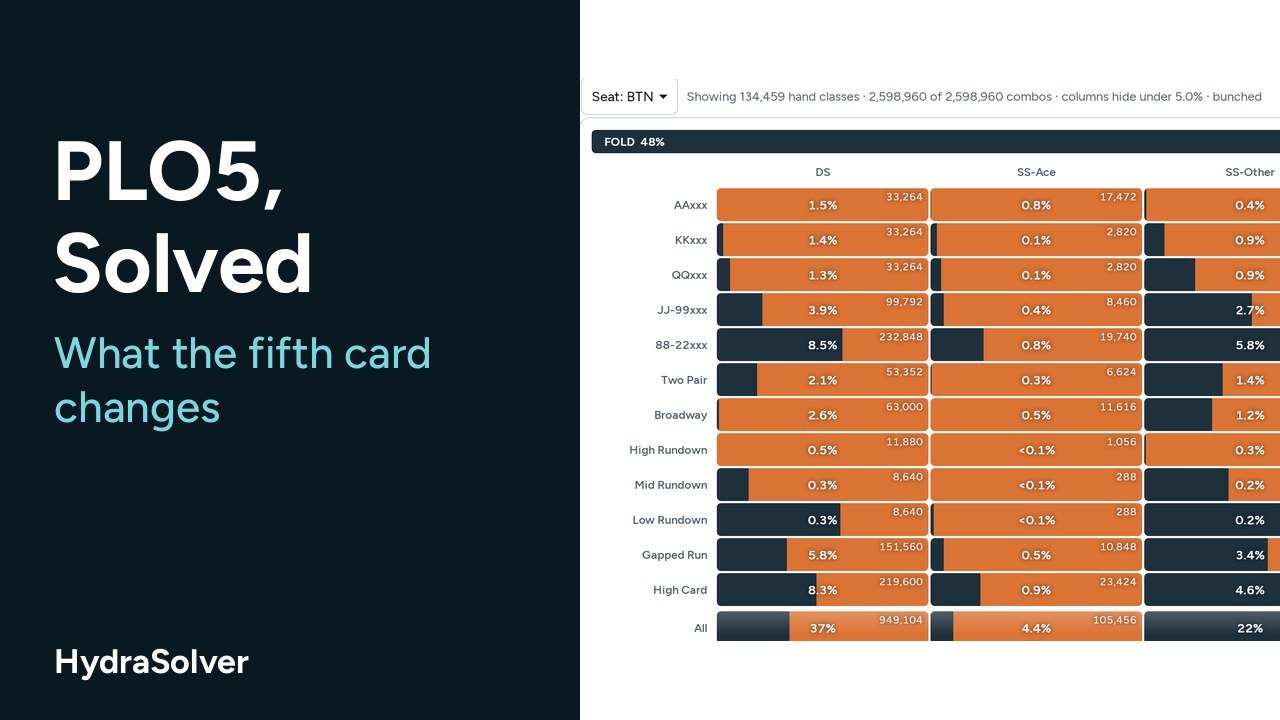 How to Solve PLO5 in HydraSolver, Step by Step
Watch on YouTube
Every step on this page, filmed as it was done: the tree, the settings, both solves, Overview, the Chart, the river and the four-card comparison.
How it was solved
- HydraSolver 1.2.04. Solve Detail Standard for both preflop solves, the one level a five-card Omaha preflop tree offers, each run until Volatility stayed at or under 1 (Auto-Stop, 5 checks in a row). The river solves are Exact.
- Accuracy reached: ≤ 1.54 bb/100 with five cards, ≤ 0.42 bb/100 with four. The river solves: 0.006% of the pot and 0.000% of the pot.
- First-in, defend and river figures come from the exported solves. The hand-shape figures are HydraSolver’s Chart with Bunching on.
- One open size, a pot raise, and a pot 3-bet. Read how we measure Omaha accuracy on the PLO5 proof.
Study it yourself
- Open these spots free
The five-card solves from this page, preflop and river, as HydraViewer files. Open them in your browser and click through every hand.
Free HydraViewer pack → - Solve your own table
Build the tree with the Tree Wizard and its PLO 6max Cash - 100bb profile: pick Omaha 5 Card Hi and five players. Leave Solve Detail on Standard. In Auto, tick Volatility at 1 for 5 checks, then Start. For the four-card solve, open the same tree and set Settings ▸ Game setup ▸ Variant to Omaha 4 Card Hi.
PLO5 Solver → - Try it for 10 days
The full version, unrestricted, for $150. Upgrade to a license for the difference at any time.
Start a trial →
More
Buy HydraSolver — $899 Try 10 days — $150 ← All strategy pages