Satellite strategy: why safe stacks fold on the bubble
We solved one six-handed No-Limit Hold’em table twice: once for chips and once as a satellite bubble, with 6 players left and 5 equal seats of $1,050 to win. The lojack is the short stack on 5bb. Every frequency on this page comes from those two solves.
What the solve says
- Folded to the hijack on 22bb, it moves all-in with every hand. Playing for chips it raises 21% of its hands and almost never moves all-in.
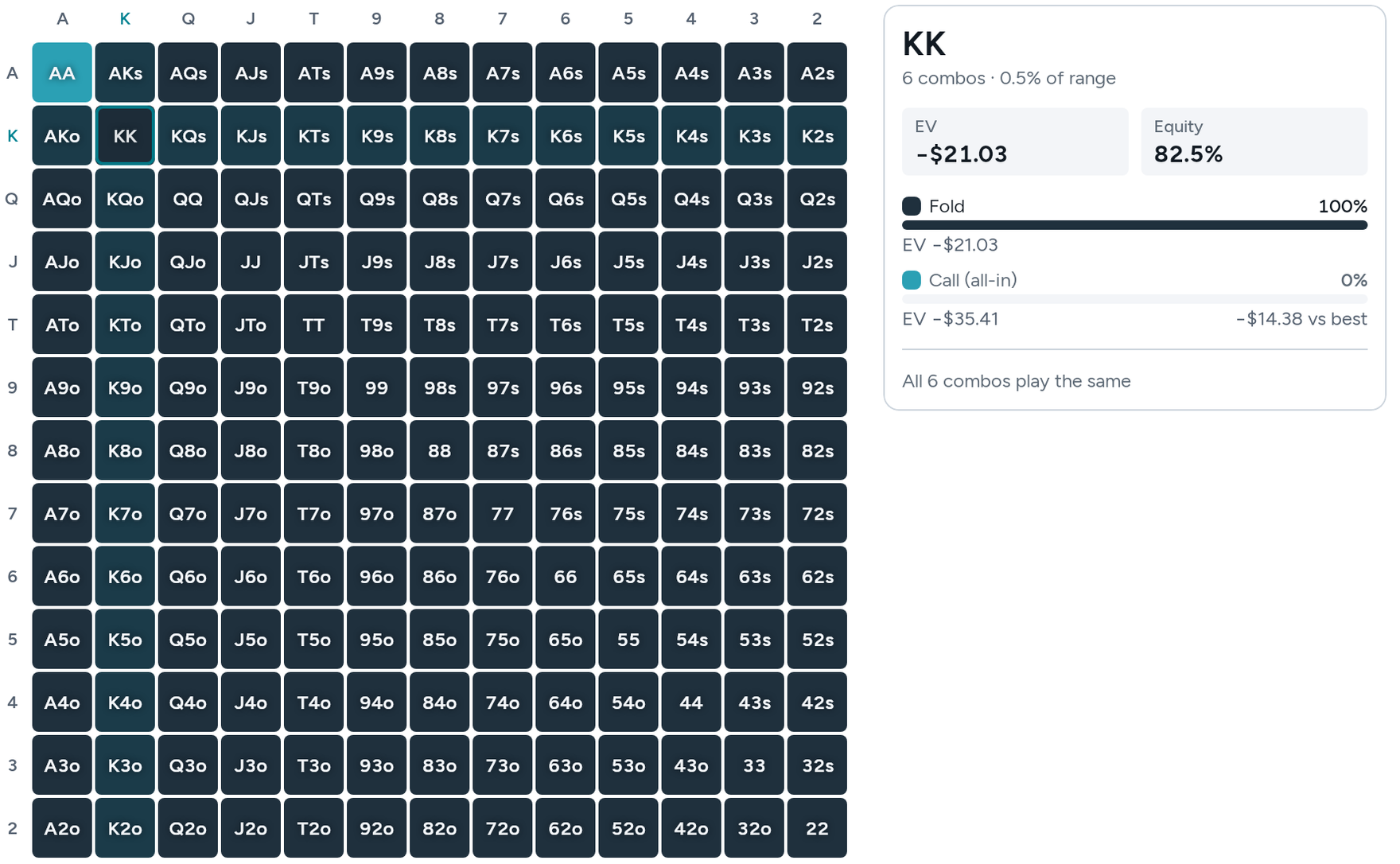
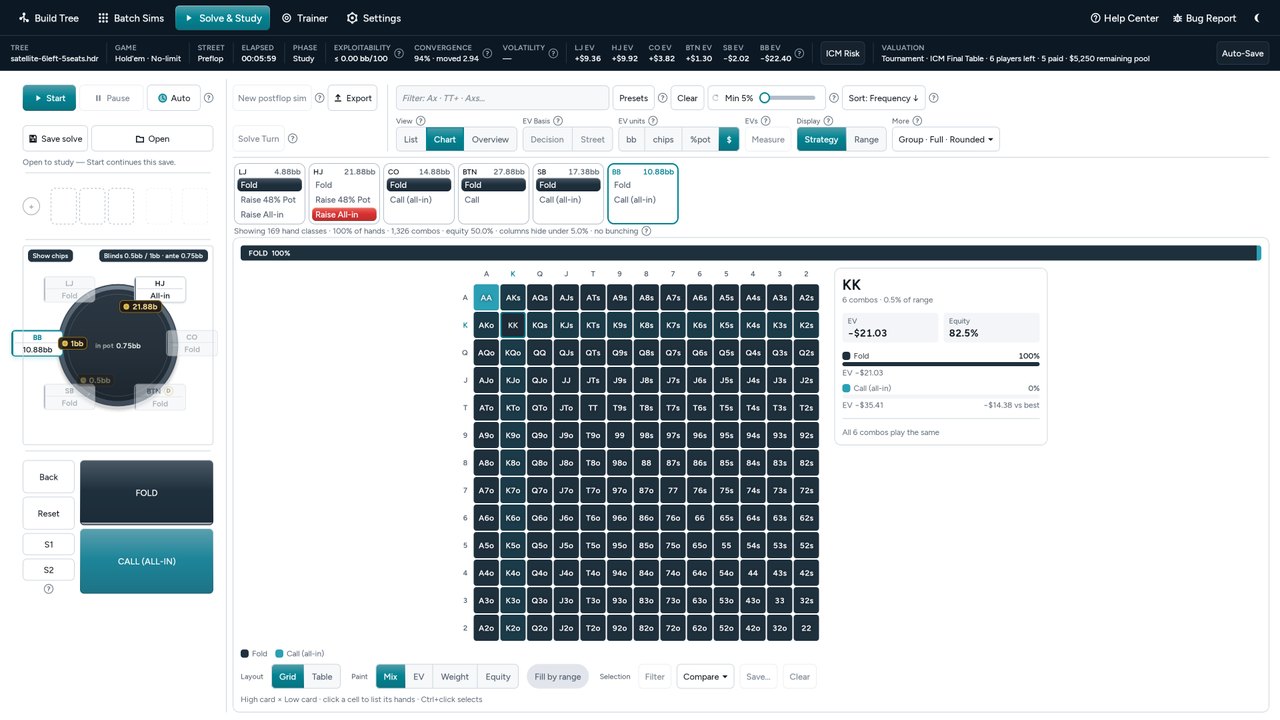
- Only aces call that all-in. The 12bb big blind calls with them, 0.5% of its hands, and folds kings.
- Against the short stack’s 5bb all-in, the big blind calls 16% of its hands, against 53% playing for chips. Compare finds 71 of 169 hand classes changing.
- The small blind stops moving all-in over the short stack. Playing for chips it moves all-in over the top with 27% of its hands; in the satellite it never does, and calls with 9%.
- The short stack itself moves all-in with 22% of its hands, fewer than the 33% it shoves for chips.
The table we solved
- Game
- No-Limit Hold’em tournament, six players left at one table: lojack, hijack, cutoff, button, small blind, big blind
- Stacks
- Lojack 5bb, hijack 22bb, cutoff 15bb, button 28bb, small blind 18bb, big blind 12bb: 100bb in play. Blinds 100 / 200 with an ante of 25 from every seat.
- Bet sizes
- The Tree Wizard’s NLH Tournaments - 40bb profile: opens to 2.2x (2.5x from the small blind), 3-bets to 2.5x in position, 3.5x out of position, and all-in at every decision.
- Prizes
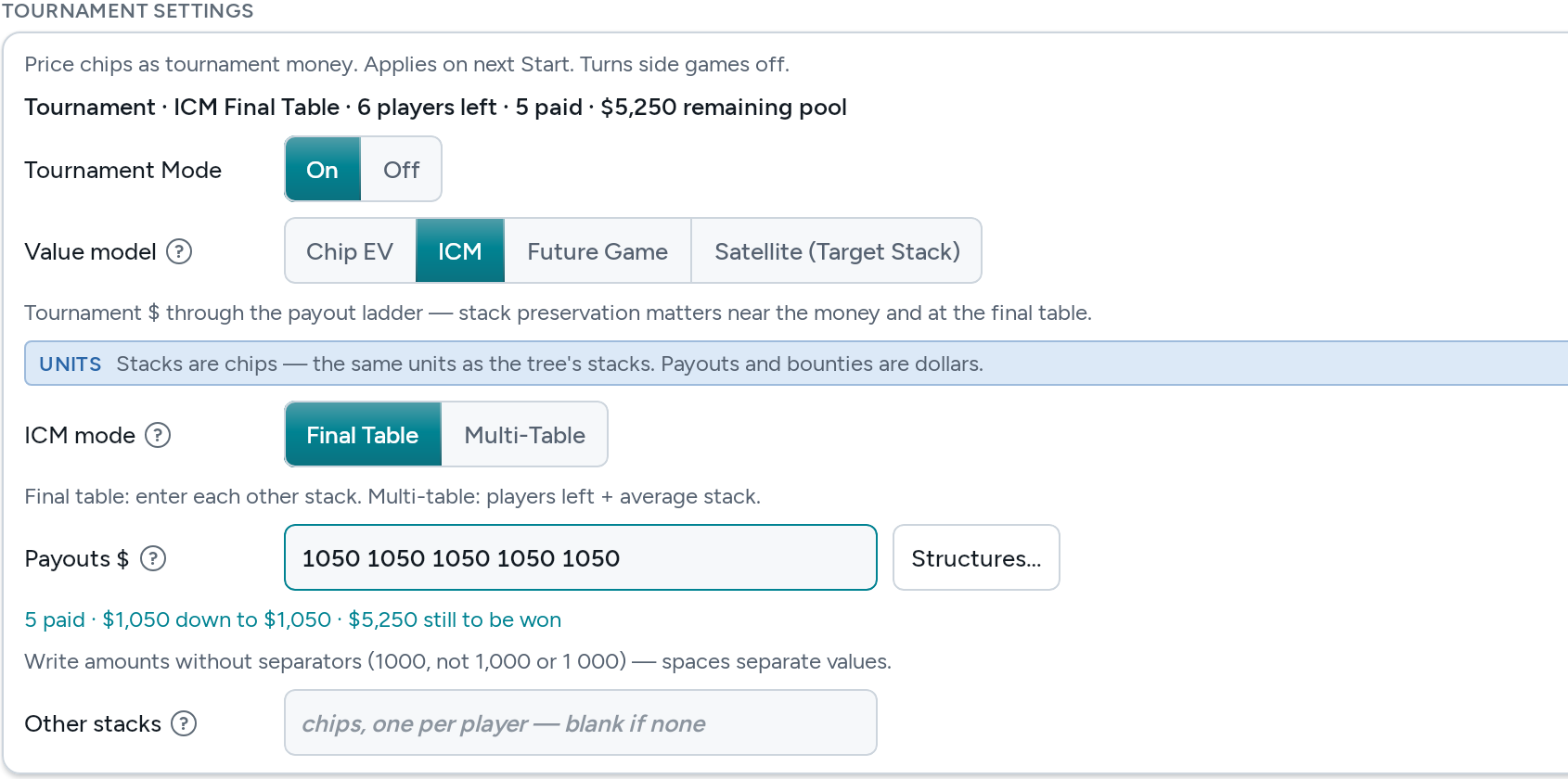
- 5 seats of $1,050 each, $5,250 in all. Sixth place wins nothing.
- Value model
- ICM, Final Table, with the five equal payouts typed in. The other solve is the same tree with Tournament Mode off, so every chip is worth the same.
- Ranges
- Every seat starts with every hand. The solves find the ranges.
Folded to the hijack: why move all-in with every hand?
The lojack folds. The hijack has 22bb and covers every stack but the button’s.
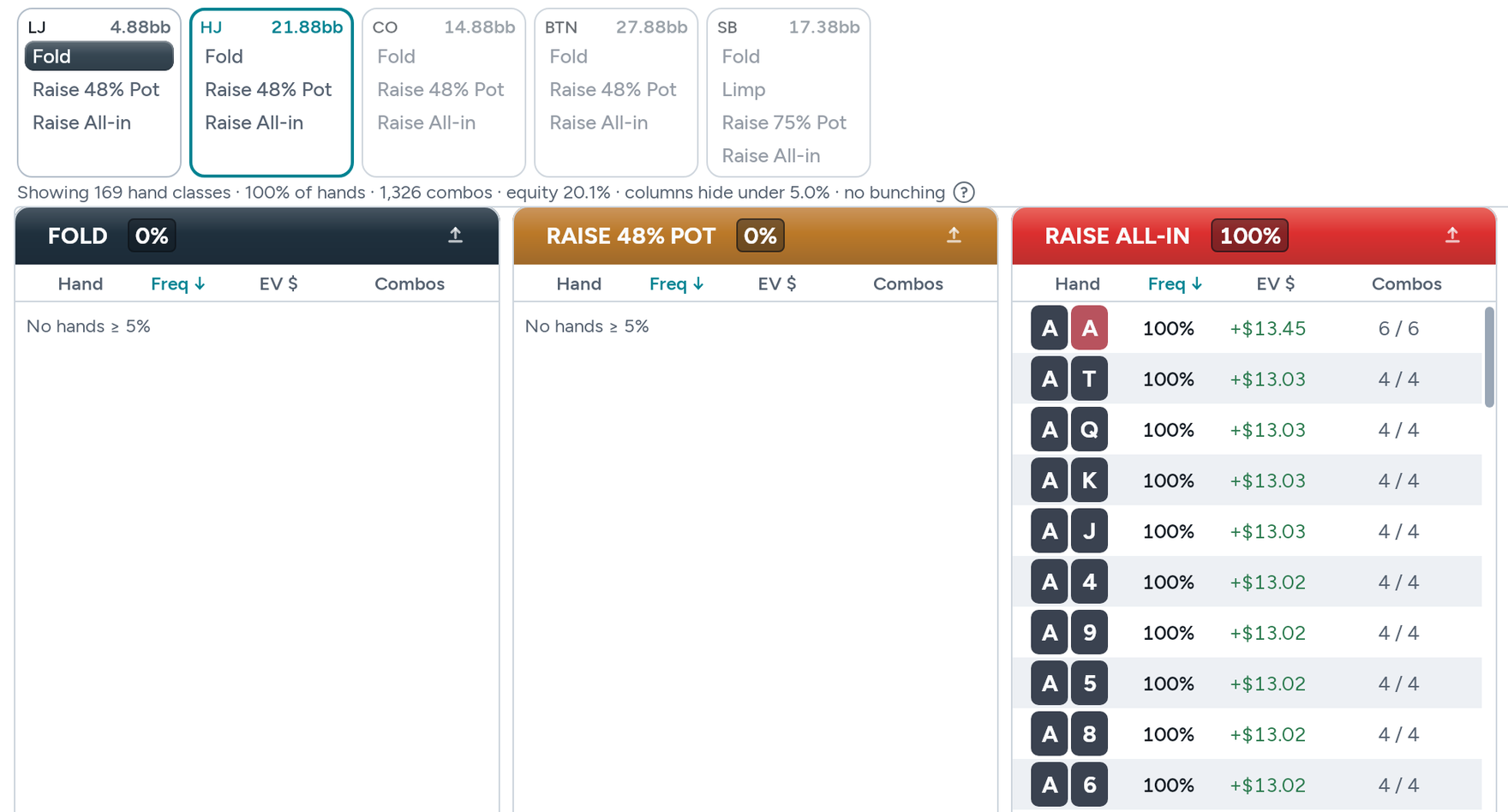
| The hijack, first in | Chips | Satellite |
|---|---|---|
| Folds | 78.3% | 0.0% |
| Raises | 21.4% | 0.0% |
| Moves all-in | 0.3% | 100.0% |
The cutoff, small blind and big blind would risk their seats to call. Even the button, which covers the hijack, loses far more by losing than it gains by winning, so the all-in takes the blinds and antes with any two cards.
Every player behind the hijack is close to a seat, and the lojack is about to be blinded away. Losing an all-in costs them far more than winning one gains, so they fold almost everything. That makes the all-in a profitable play for every hand the hijack holds.
The hijack moves all-in: who calls?
The lojack folds and the hijack moves all-in for 22bb. The cutoff, button and small blind fold. The big blind has 12bb.
| Against the hijack’s all-in | Calls | Folds |
|---|---|---|
| Cutoff | 0.0% | 100.0% |
| Button | 0.0% | 100.0% |
| Small blind | 0.0% | 100.0% |
| Big blind | 0.5% | 99.5% |
The satellite solve. Playing for chips the hijack almost never moves all-in first, so this spot has no fair comparison there.
The cutoff, button and small blind fold every hand, aces included. The big blind has a blind in the pot and calls with aces, and only aces: with kings, folding keeps more of its tournament equity than calling.
Why kings fold: the price of losing
The same spot, read with ICM Risk.
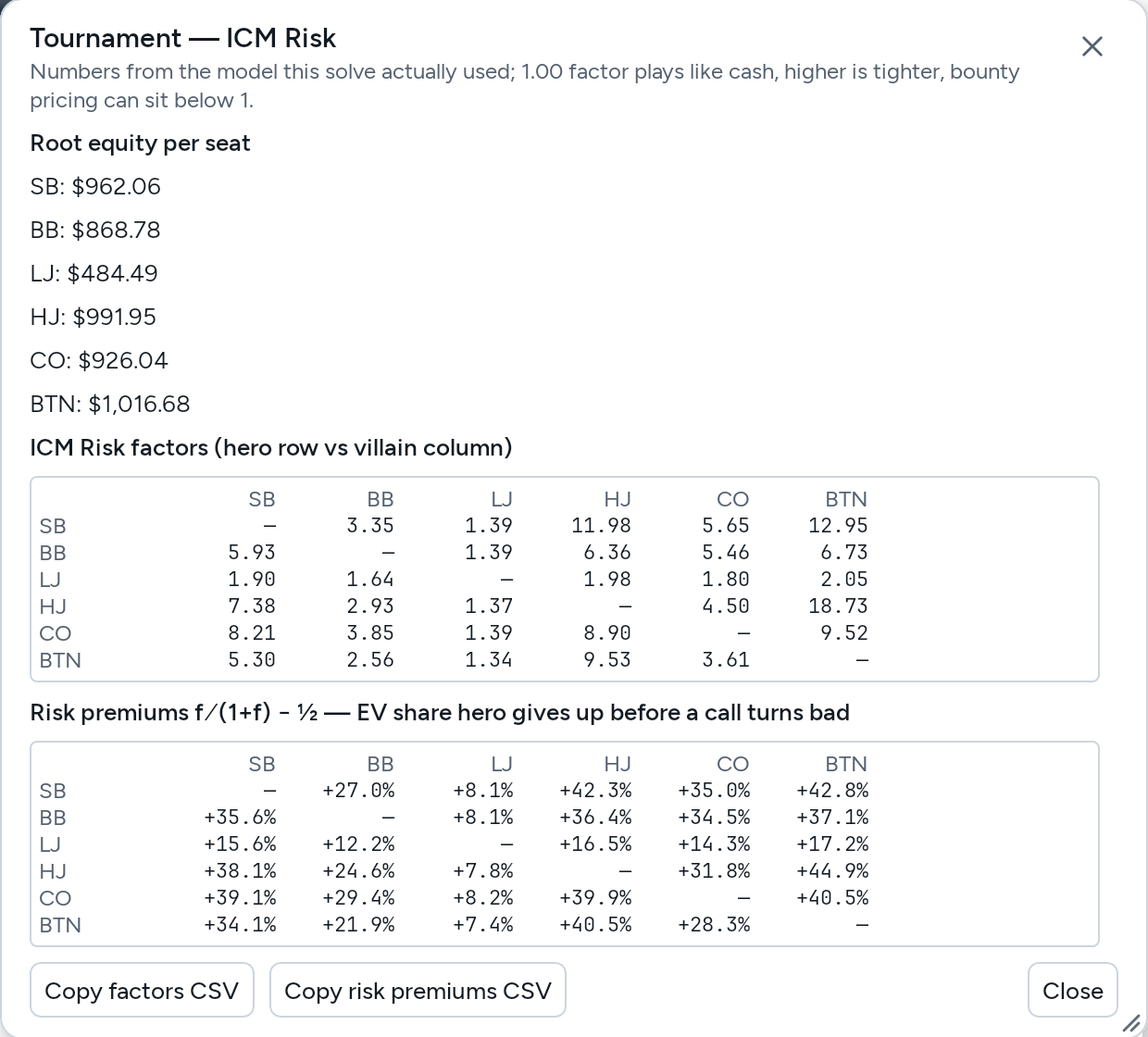
| The big blind against the hijack | Satellite |
|---|---|
| Risk factor | 6.36 |
| Risk premium | 36.4% |
| Equity a call needs, with no blinds or antes in the pot | 86.4% |
| The big blind’s tournament equity before the hand | $868.78 |
The risk premium is how much equity the big blind needs above an even all-in. The blinds and antes already in the pot lower it a little.
A risk factor of one is a cash game: losing and winning cost the same. Here losing the big blind’s stack costs it more than six times what winning the same chips gains, because the stack it would bust is already worth most of a seat. Kings have plenty of equity against a hijack that moves in with any two cards, but not enough to pay that price.
The short stack moves all-in: how wide does the big blind call?
The lojack moves all-in for 5bb. The hijack, cutoff, button and small blind fold. The big blind has 12bb.
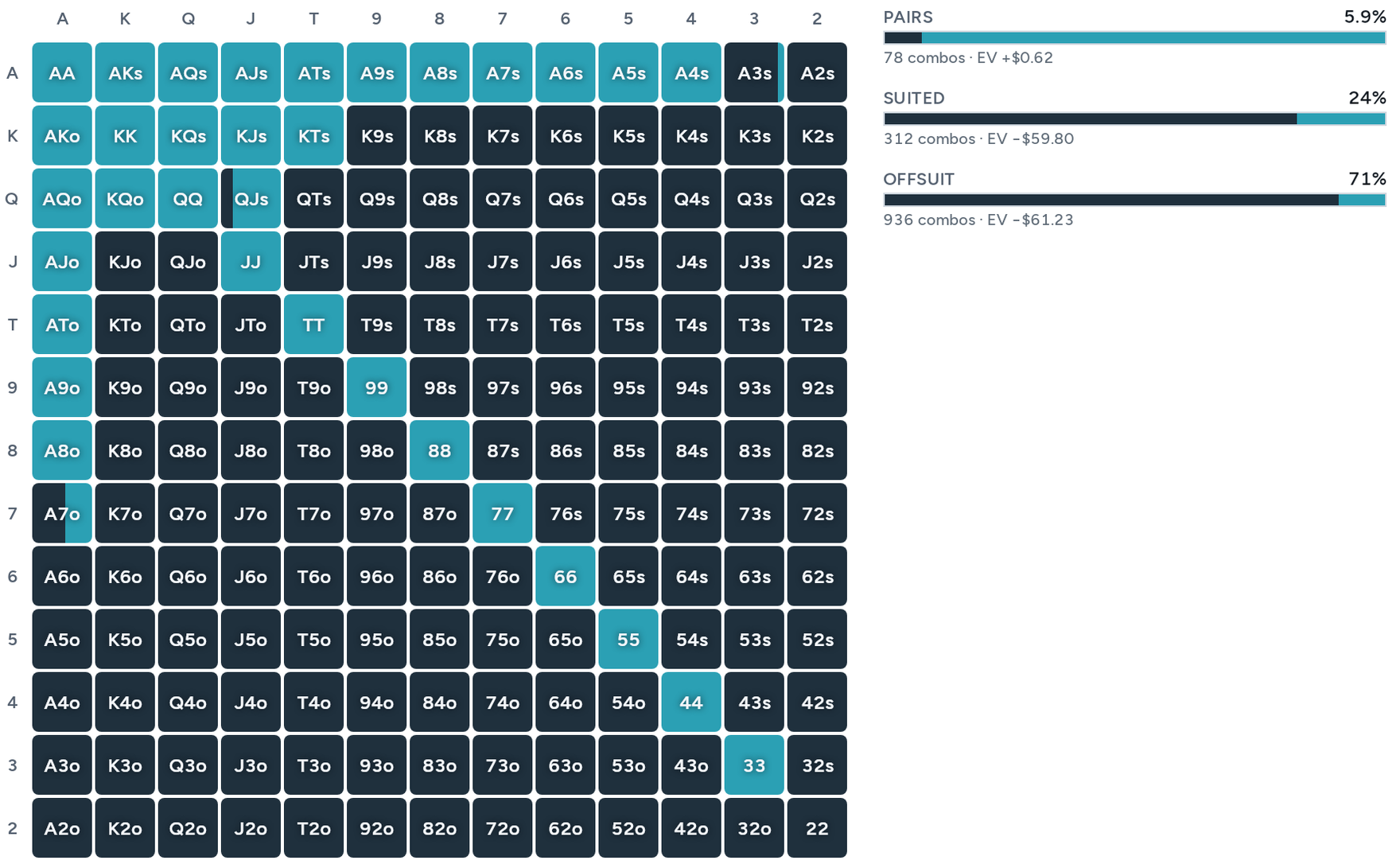
| The big blind against the short stack | Chips | Satellite |
|---|---|---|
| Calls | 52.6% | 16.4% |
| Folds | 47.4% | 83.6% |
The short stack moves all-in with 33.0% of its hands playing for chips and 22.1% in the satellite.
Here the big blind covers the all-in, so a loss does not bust it. It still calls far less than it would for chips: a loss leaves it the shortest stack at the table, and a fold costs only the blind and ante it has posted.
Which hands stop calling?
The same spot, compared hand by hand with the solve played for chips.
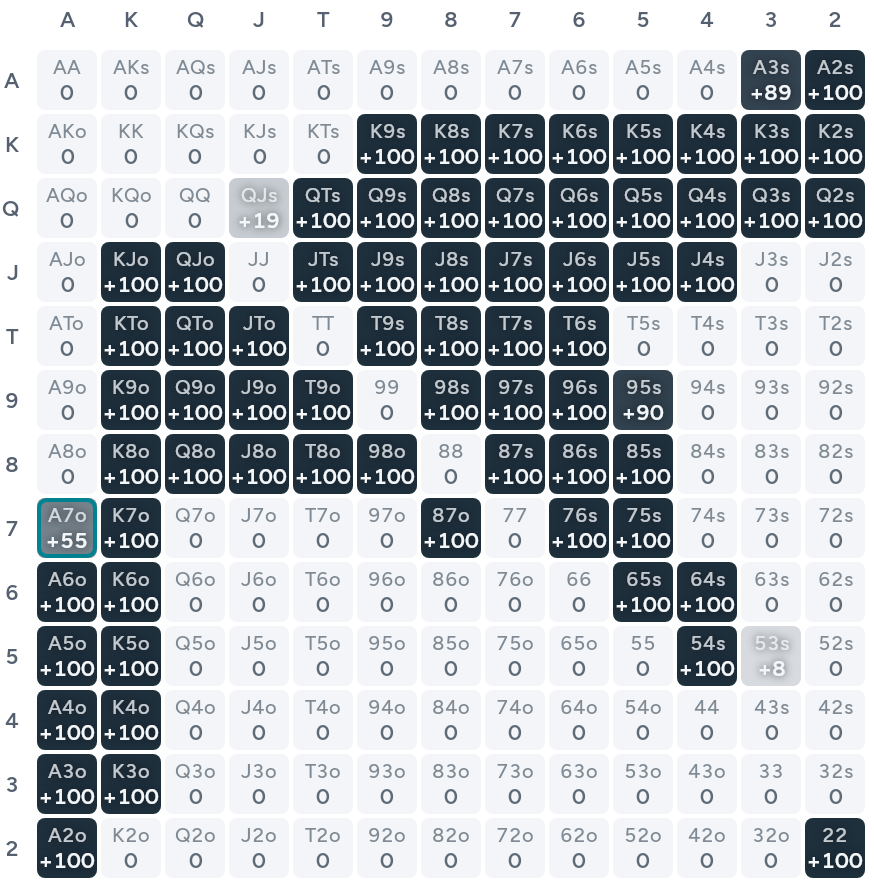
| Calls the short stack | Chips | Satellite |
|---|---|---|
| King-nine suited | 100% | 0% |
| King-jack offsuit | 100% | 0% |
| Queen-jack offsuit | 100% | 0% |
| King-five offsuit | 100% | 0% |
| Ace-two offsuit | 100% | 0% |
| Pair of twos | 100% | 0% |
Compare’s own count at this spot: 71 of 169 hand classes move a point or more.
For chips the big blind calls with every ace, every king but king-two offsuit, most queens and connected cards. In the satellite it keeps pairs from threes up, aces down to ace-eight offsuit and ace-four suited, and the biggest broadway hands. The weak aces, the suited kings below ten, the smaller offsuit broadway hands from king-jack and queen-jack down, and twos all stop calling. A few hands sit right on the line: ace-seven offsuit calls for −$64.88 and folds for −$65.05, so it mixes, and how often it calls is not worth reading into.
The small blind over the short stack: move all-in or call?
The lojack moves all-in for 5bb. The hijack, cutoff and button fold. The small blind has 18bb and the big blind is still to act.
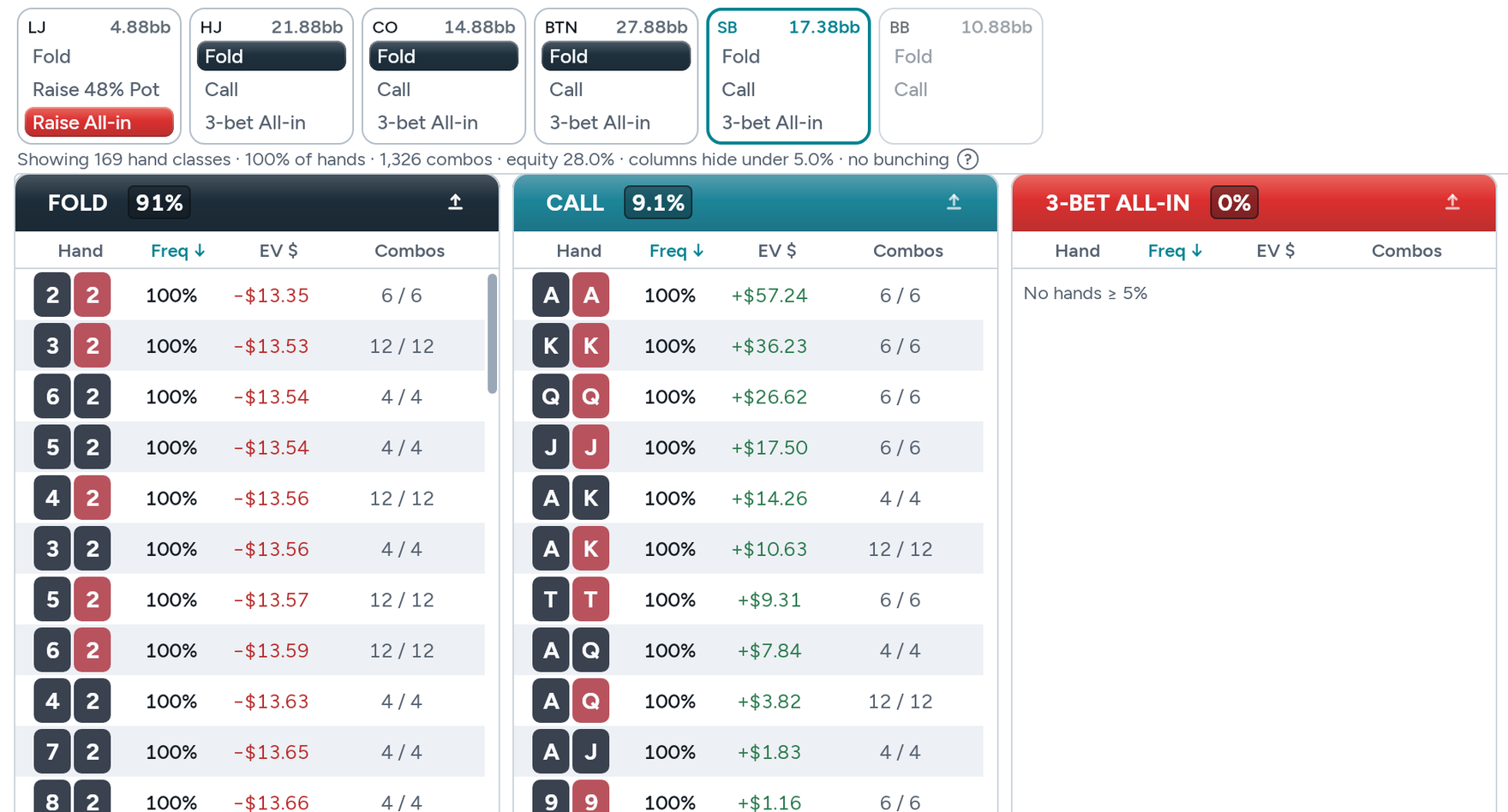
| The small blind against the short stack | Chips | Satellite |
|---|---|---|
| Folds | 72.1% | 90.9% |
| Calls | 1.1% | 9.1% |
| Moves all-in over the top | 26.8% | 0.0% |
With aces, calling is worth +$57.24 and moving all-in +$57.14.
Playing for chips the small blind often moves all-in over the top. In the satellite it never does: it calls with every hand it plays, and with its best hands calling and moving all-in are worth almost the same.
Every seat against the short stack’s all-in
The lojack moves all-in for 5bb. How often each seat behind it plays, when the seats before it fold.
| % of hands | Chips | Satellite |
|---|---|---|
| Hijack calls | 9.8% | 5.4% |
| Cutoff calls | 4.8% | 6.3% |
| Cutoff moves all-in over the top | 9.5% | 0.0% |
| Button calls | 6.0% | 7.1% |
| Button moves all-in over the top | 10.6% | 0.0% |
| Small blind calls | 1.1% | 9.1% |
| Small blind moves all-in over the top | 26.8% | 0.0% |
| Big blind calls | 52.6% | 16.4% |
The cutoff and button call a little more often in the satellite, 6.3% and 7.1%, only because they stop moving all-in over the top: in all they play less than half as many hands.
At the table
- Near the seats, when everyone behind you is close to one, move all-in wide: the hijack here moves all-in with every hand once the lojack folds.
- When an all-in could bust you short of a seat, fold all but the very best hands. The big blind folds kings to the hijack’s all-in and calls with aces only.
- Against a short stack’s all-in that cannot bust you, still tighten up: the big blind calls 16% of its hands, against 53% for chips. And don’t move all-in over the top: just call.
How this solve was created
 How to Solve a Satellite Bubble in HydraSolver, Step by Step
Watch on YouTube
Every step on this page, filmed as it was done: the tree, the solve for chips, the satellite settings, the satellite solve, the hands that fold, ICM Risk, Compare and the export.
How it was solved
- HydraSolver 1.2.12. Solve Detail Standard, each solve run until Volatility stayed at or under 0.5 (Auto-Stop, 5 checks in a row).
- Accuracy reached: ≤ 0.02 bb/100 for chips, ≤ 0.00 bb/100 in the satellite. We let the satellite solve run on past its stop, and no spot’s overall frequency on this page moved more than 0.24 points. Single hands that are worth the same either way, such as ace-seven offsuit against the short stack, still swap between call and fold, so the page quotes none of their mixes.
- Every frequency is as HydraSolver’s List and Chart show it. Tournament EVs are in dollars of equity, as the app shows them with EV units set to $.
- In the satellite the hijack moves all-in with every hand, so the lines where the cutoff, button or small blind play first are never reached. The page compares only spots both solves reach.
- One open size per seat, one 3-bet size, and all-in at every decision. Read how we measure accuracy on the No-Limit Hold’em proof.
Study it yourself
- Open these spots free
The satellite solve from this page as a HydraViewer file. Open it in your browser and click through every hand.
Free HydraViewer pack → - Solve your own table
Build the tree with the Tree Wizard and its NLH Tournaments - 40bb profile at six players, then open Per-seat stacks and type each seat’s stack. In Settings, Game setup, turn Tournament Mode on, pick ICM and Final Table, and type the payouts: one equal amount per seat paid. In Auto, tick Volatility at 0.5 for 5 checks. Then Start. ICM Risk, on the Solve strip, shows each seat’s risk factor against every other.
Satellite Solver → - Try it for 10 days
The full version, unrestricted, for $150. Upgrade to a license for the difference at any time.
Start a trial →
More
Buy HydraSolver — $899 Try 10 days — $150 ← All strategy pages